Reading text
1.1 Understanding the rationale and objectives of the OPTIMA project
1.1.1 Understand the importance of partnership in the OPTIMA project.
The partnership in the OPTIMA project brings together producer organizations and aquaculture stakeholders from France, Ireland, Spain, Italy and Greece, ensuring the project results work in the real world and meet the specific needs of the sector. In particular, organizations such as CNC (Comité national de la conchyliculture) for France, IFA (Irish Farmers’ Association) for Ireland and CRMG (Cooperativa de Rías Baixas) for Spain represent the production sector, providing direct insight into the practical requirements of shellfish farming and ensuring that the project results are applicable within real production environments. From a technical and educational perspective, M.A.R.E. and Demetra Formazione play a central role in the project. They are responsible for the design and development of Vocational Education and Training (VET) content, integrating scientific knowledge with structured training pathways directed at strengthening the skills and professional competencies of aquaculture workers. The technological development and quality assurance components are provided by IDEC (Innovation and Development in Education and Consulting S.A.) in Greece and SGS Tecnos in Spain. The first contributes to the design and implementation of digital e-learning solutions, enabling accessible, flexible, and scalable training delivery across partner countries, the second is responsible for quality assurance and certification processes, ensuring that training standards are consistent, reliable, and recognized at European level. The transnational configuration of OPTIMA enables the comparison and integration of different production models, contributing to the development of coherent training approaches and shared operational frameworks across European aquaculture systems.
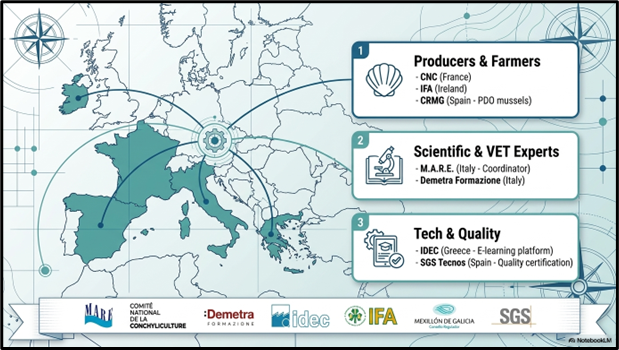
Fig. 1. OPTIMA project partnership.