Reading text
2.2 Issues and solutions related to the problems present in the countries involved in the project: diseases, predators, alien species, sea temperature, climate change, sea storms
2.2.3 Problems related to potential predators or impacting alien species in each country
Predation and the ecological and economic impact of harmful species are rapidly growing problems throughout Europe. To fully understand the phenomenon, it is essential to distinguish between two fronts: on the one hand, the pressure exerted by local (native) predators, with which the sector has historically coexisted; on the other, the new threats posed by invasive (non-native or alien) species. Global warming, combined with the intensification of maritime traffic (which can transport larvae or adult organisms in ballast water or on the hulls of ships), is profoundly altering the balance of coastal ecosystems, in some cases favoring the rapid establishment of highly competitive alien species.
In Italy, the sector faces problems particularly concerning alien species, but native predators can also cause significant damage. Regarding native threats, offshore and coastal mussel farming often finds it difficult to coexist with the common gilt-head bream (Sparus aurata), which can feed on mussels in large quantities. The powerful jaws of local sea bream literally shatter the shells of growing mussels, forcing farmers to incur extremely high costs to cover the awns with heavy, predator-proof nets. Along the Adriatic, these problems are usually caused by sea turtles (Caretta caretta), which often feed on bivalves. In this case, predation, also due to the turtles' strong, leathery beaks, can lead to the rupture of the plastic bag containing the mussels, resulting in the loss of the entire portion of product.
An even more significant problem is caused by a non-native species: the blue crab Callinectes sapidus. This alien species, native to the Atlantic coasts of the United States, is literally decimating clam (Ruditapes philippinarum) farms in the northern Adriatic. The blue crab preys mercilessly on both juvenile and adult clams, its strong claws capable of cutting through the bottom nets that increasingly cover the product. Furthermore, this species reproduces exponentially, benefiting from the absence of local natural antagonists.
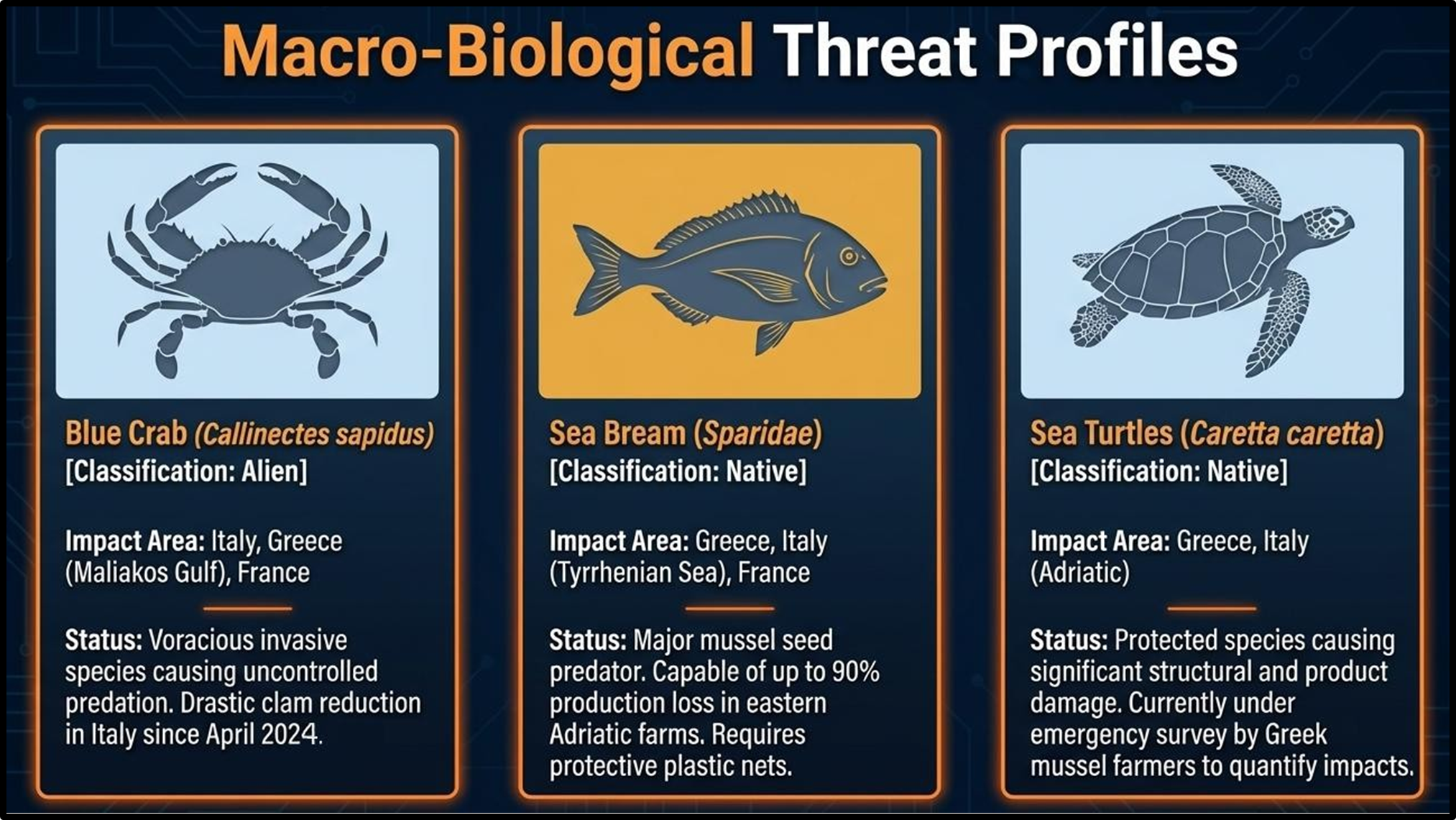
Fig. 17 - Main predators of molluscs in Italy and Greece
Also in Greece, mussel farming faces intense predation pressure, currently predominantly indigenous. Just as in Italy, the long rows of mussels suspended in the rich Greek gulfs provide an easily accessible food source for large schools of wild sea bream and local sea turtles. The only feasible defense is to place the mussels within protective nets. However, Greek authorities and farmers are also raising the alert level for non-native species, monitoring the progressive spread of alien species such as the blue crab in their seas, which threatens to extend its damage to Greek ecosystems.
In Spain, in the productive Galician estuaries, damage to mussel farms is clearly divided between natural predation and invasive biofouling. Mussels farmed on bateas have historically been preyed upon by native species such as starfish (Asterias rubens) and various local coastal fish species. However, the most insidious problem in this area today is linked to the expansion of non-native encrusting species, particularly Asian tunicates (such as Styela clava) and specific invasive macroalgae. These alien organisms do not act as direct predators, but rather engage in vital spatial and trophic competition with the bivalves: by settling en masse on the culture ropes, they slow the mussels' growth and, combined with their own weight, eventually break the ropes, causing them to fall to the seabed.
In France and Ireland, nations with a strong oyster farming tradition, threats take different forms in intertidal ecosystems, but they reflect the same divide. On one side are native predators: oysters farmed in pouches are traditionally targeted by starfish, native green crabs (Carcinus maenas), and seabirds, whose impact is mitigated using traditional methods. On the other, the sector is plagued by parasites and non-native competitors. A serious problem in France (and a constant risk for Ireland) is posed by predatory alien gastropods, the so-called "oyster drills," most notably the invasive Asian species
Ocinebrellus inornatus, which can pierce the oyster shell to consume its soft tissue. Another serious alien plague, now endemic to Brittany and Normandy, is the crepidula (Crepidula fornicata): this mollusc of North American origin does not directly prey on bivalves, but behaves as a fierce spatial competitor, forming dense, stratified colonies that alter the benthic ecosystem and suffocate the oysters.