Reading text
2.4 National and European regulations, directives, and legal procedures relating to bivalve mollusc aquaculture: EU regulations, food safety directives, classification of aquaculture production areas
2.4.2 Official Controls and National Implementation: The Role of Supervision
The European Union's official control system underwent a profound overhaul with the entry into force of Regulation (EU) 2017/625, becoming one of the most advanced models of multilevel regulatory governance in the agri-food sector to date. The regulatory framework integrates controls relating to food safety, feed, animal health, and plant protection into a single legal framework, with the aim of ensuring consistent, effective, and risk-based application of EU law throughout the entire supply chain. Implementation at the national level is carried out by competent authorities, and Member States are responsible for carrying out official controls. Supervision at the national level ensures coordination between central authorities and local bodies, verifying the uniformity of procedures and the quality of inspection activities. At the European level, the Commission, through audits, inspections, and system analyses, oversees the effectiveness of national authorities, helping to ensure harmonized application of the rules. At the operational level, supervision is structured along two complementary dimensions: an ex-ante evaluation, aimed at verifying the appropriateness of control systems before their implementation, and ex-post monitoring, aimed at the timely identification and correction of non-compliance. Although the primary responsibility for compliance lies with food business operators, the public control system is ultimately responsible for protecting consumer health and ensuring transparency in the single market, ensuring such adequacy through corrective measures such as administrative sanctions and verification and monitoring actions.
In Italy, the system is characterized by Regulation (EU) 2017/625, which has led to a significant process of regulatory and organizational adaptation, strengthening internal supervision mechanisms through the formalization of control procedures and the introduction of tools such as the "second expert opinion" (SEO) for managing technical disputes. The introduction of this right, guaranteed to food business operators, allows companies to challenge the results of official controls. Territorial variability in the application of procedures persists, necessitating the strengthening of central coordination mechanisms.
In Greece, the management of official controls is characterized by greater institutional fragmentation. The implementation of the European framework has contributed to strengthening central coordination, but critical issues remain related to operational coherence and the ability to ensure uniform supervision across the territory. In this context, the role of European audits and the Commission's control mechanisms is particularly important in supporting the progressive improvement of national administrative capacities.
Spain, on the other hand, has a semi-centralized model, in which the autonomous communities play a significant operational role, while the central authority, the Agencia Española de Seguridad Alimentaria y Nutrición (AESAN), ensures coordination and alignment with the European regulatory framework while maintaining a high degree of territorial autonomy.
In France, the official control system is highly centralized and primarily entrusted to the Directorate General of Food (DGAL). The French administration relies on a clear chain of command, in which supervision is closely integrated with control planning and risk management, reducing fragmented decision-making.
A different model is represented in Ireland, where the Food Safety Authority of Ireland (FSAI) plays a central coordination and supervision role. The Irish system is characterized by a strongly embedded institutional structure and a clear assignment of roles among competent authorities, with a level of uniformity in the execution of official controls.
Supervision emerges as a structural element of the official control system, as it ensures consistency between the European and national levels, strengthening the accountability of competent authorities and regulatory effectiveness.
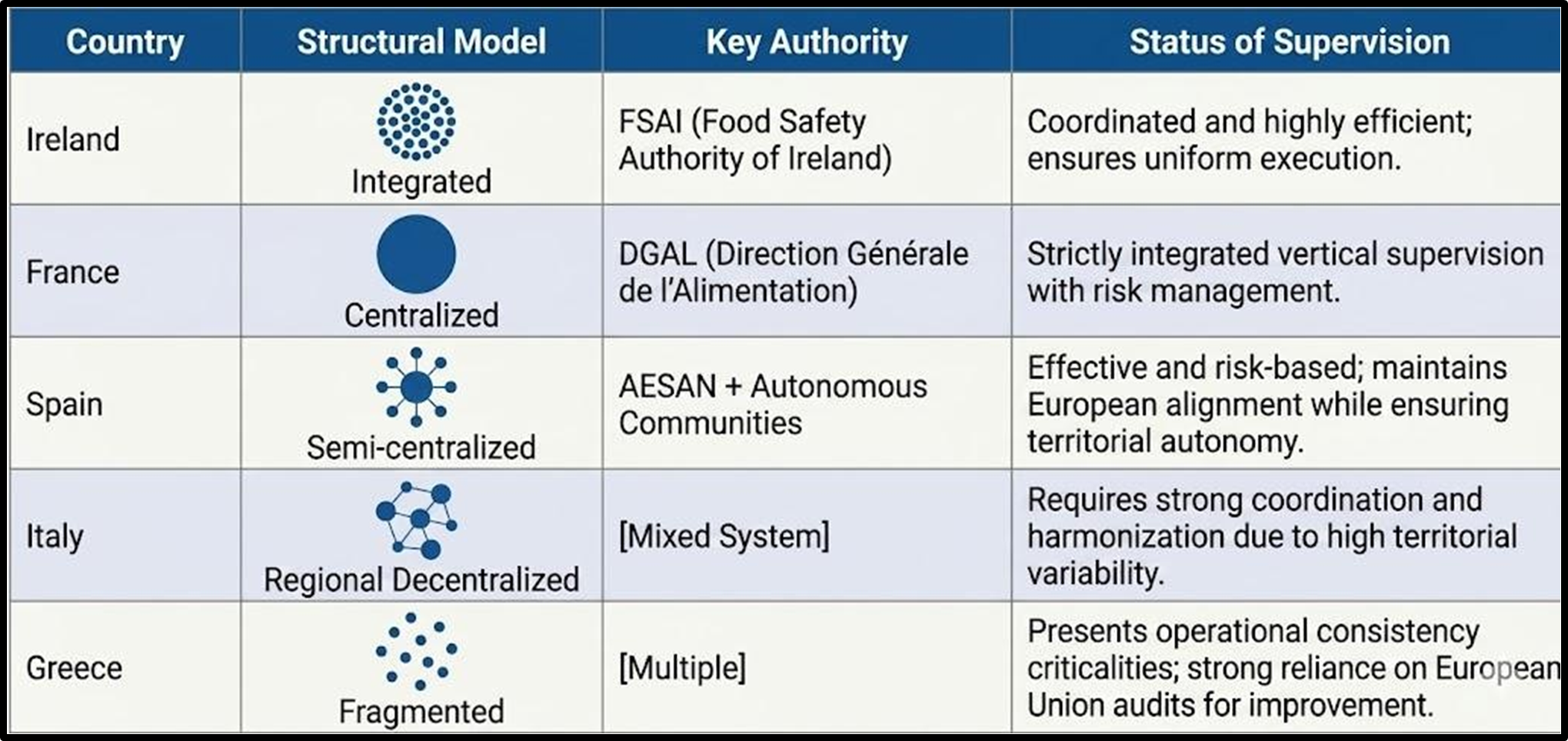
Fig. 19 - Comparative analysis of the official control supervision systems in the OPTIMA project countries