Reading text
3.2 Impact of bivalve mollusc aquaculture: carbon Footprint analysis and Life Cycle Assessment
3.2.2 Know better the Carbon Footprint and the LCA
Assessing the carbon footprint of marine bivalve aquaculture certainly requires an accurate estimate of the CO2 release associated with capital goods and aquaculture operations, but it is important in this case to also consider the metabolic CO2 budget of the farmed species (Alvarez-Salgado et al, 2022). Site-specific environmental conditions and culture methods also significantly influence the estimates.
Numerous studies have shown that bivalve mollusc aquaculture has a significantly lower carbon footprint than other animal productions, such as cattle or pig farming. This is mainly due to the fact that bivalve molluscs are fast-growing animals and have low energy requirements, as they feed mainly by filtering seawater (Crawford et al., 2003; Dumbauld et al., 2009).
The ability of bivalve molluscs to sequester carbon is also a topic of growing interest in scientific research. Through the process of filtration, these organisms assimilate calcium carbonate from seawater to form their shells. This calcium carbonate, once deposited on the seabed when the organism dies, can remain sequestered for thousands of years, thus helping to reduce atmospheric carbon dioxide concentrations.
Carbon sequestration mechanisms:
- Biomineralization: Shell formation is the primary process by which bivalve molluscs sequester carbon.
- Sedimentation: Upon death, shells settle to the seafloor, contributing to the formation of calcareous banks and sediments.
Factors influencing carbon sequestration:
- Species: Different bivalve mollusc species have different growth and calcification rates, influencing the amount of carbon sequestered.
- Environmental conditions: Temperature, salinity, food availability and other environmental factors can influence the growth and calcification of molluscs.
- Farm management: Farm management practices, such as stocking density and harvest frequency, can influence the amount of carbon sequestered.
- Farming system: There are different farming techniques, each with its own advantages and disadvantages in terms of sustainability.
- Location: The environmental conditions of the farm site (e.g. water quality, depth, currents) significantly influence the impact.
- Waste Management: Proper management of waste produced by livestock farming is essential to minimize pollution.
Bivalve aquaculture has an exceptionally low carbon footprint: Greenhouse Gas (GHG) emissions for mussel, oyster and rope-cultured bottom mussel production are 107 kg CO2 eq./tonne, 235 kg CO2 eq./tonne and 824 kg CO2 eq./tonne respectively.
Diesel fuel use for workboats is the largest GHG emitter for mussels, accounting for almost 90% of emissions. Consumables in the mussel sector account for only a small fraction of total emissions (less than 10%).
Similarly, diesel fuel for tractors was the largest GHG emitter in the oyster sector, accounting for almost 60% of emissions.
Overall, emissions from the Irish bivalve mollusc aquaculture sector are low, contributing less than 1% of Irish seafood greenhouse gas emissions.
To further reduce the carbon footprint of bivalve mollusc aquaculture, sustainable management and circular economy practices are needed.
In the bivalve mollusc aquaculture field, the application of circular economy principles can lead to significant environmental and economic benefits.
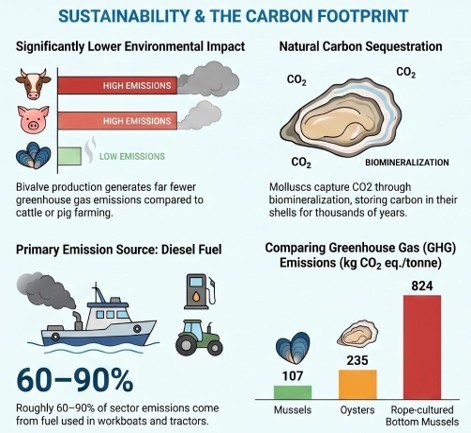
Fig. 21 - Difference in carbon footprint between livestock and bivalve farming. Main impacts of bivalves
- Optimizing energy consumption: Use of renewable energy, improving energy efficiency and adopting monitoring and control systems.
- Reduction, reuse and recycling: Minimize waste production, reuse materials and products for as long as possible and recycle those that are no longer usable.
- Optimizing logistics: Reducing transport distances and using eco-sustainable
- Valorisation of by- products: Recovery and valorisation of by-products from bivalve processing, such as shells, to reduce waste and generate new products.
- Integrated aquaculture: Integrating aquaculture with other activities, such as breeding other species, can optimize the use of resources and reduce environmental impacts.
Aquaculture produce has a small carbon footprint which will contribute to the statutory carbon reduction targets. Low carbon food production enterprises have the potential to increase availability and food security of nutritious seafood to consumers.
Assessing the carbon footprint of marine bivalve aquaculture demands an accurate estimation of the CO2 release associated to capital goods and aquaculture operations but also to the metabolic CO2 budget of the farmed species (Alvarez-Salgado, 2022).
There are discrepancies on the considered processes: how to include and estimate the carbon budget, and how the scale should be applied ranging from individual to ecosystem. Site-specific environmental conditions and culture methods also significantly affect the estimates.
Alvarez-Salgado et al, 2022 found in their study of the metabolic CO2 budget for mussel aquaculture in the coastal inlets of the Northwest Iberian upwelling that there was large variability depends on mussel seeding time and harvesting size, due to the differential seasonal growth patterns of flesh and shell.
Inclusion of the CO2 potentially immobilised in mussel faeces buried in the sediments would lead to a reduction of the metabolic carbon footprint estimates by up to 6 % compared with the individual estimates.