Completion requirements
2.1 Main differences between the countries involved in the project
2.1.1 Main species farmed in each country, quantities produced, and spatial distribution within the country
By analyzing the species farmed in the five countries participating in the OPTIMA project consortium, substantial differences emerge.
In Spain, the sector is almost entirely dominated by the Mediterranean mussel (Mytilus galloprovincialis). The Iberian nation is the European leader of mussel production with impressive volumes exceeding 200,000 tonnes per year. Production is heavily concentrated in the region of Galicia (in the northwest of the country), where the "rías" (deep coastal inlets, particularly the Rías Baixas such as Arousa, Pontevedra, and Vigo) offer an exceptionally fertile environment, rich in nutrients brought by ocean upwelling currents. In addition to mussels, Spain also boasts smaller but significant oyster production, including the Pacific cupped oyster (Magallana gigas) and the prized native flat oyster (Ostrea edulis). Moving to the Mediterranean coast (Catalonia, the Ebro Delta, and the Valencian Community), there are further mussel and oyster production hubs operating in the open sea or in sheltered bays.
In France, production stands out for being strongly oriented towards oyster farming and very well distributed along the coast. The leading species is the Pacific cupped oyster, which alone reaches volumes of approximately 80,000 tons per year. This is complemented by the historic and highly valuable niche production of the flat oyster (Ostrea edulis). Mussel farming is equally important: both the Atlantic mussel (Mytilus edulis) is farmed, with approximately 45,000 tons annually, and the Mediterranean mussel (Mytilus galloprovincialis), which contributes approximately 10,000 tons. The geographical distribution covers the entire Atlantic coast (from the Belgian border to Spain, including the major centers in Brittany, Normandy, Pays de la Loire, and Nouvelle-Aquitaine) and the Mediterranean coast (Occitania, where the Thau Estuary stands out). Minor production in France also includes sea truffles, clams, and scallops.
Italy stands out for its strong production dualism. On the one hand, mussel farming (Mytilus galloprovincialis) dominates, widespread throughout the peninsula but with centers of absolute excellence along the Adriatic coast (Emilia-Romagna, Marche, Veneto, and Puglia, with the renowned Taranto hub) and along the Tyrrhenian coast in Liguria (Gulf of La Spezia). On the other hand, venericulture, or the farming of the Philippine clam (Ruditapes philippinarum), is dominant, a sector in which Italy holds the undisputed European leadership. This production is concentrated almost entirely in the fragile lagoonal and transitional ecosystems of the Northern Adriatic (Po Delta, Sacca di Scardovari, Sacca di Goro, Venice Lagoon, Marano Lagoon, and Grado). In recent years, the farming of the Pacific cupped oyster has also become increasingly popular and significant, reaching high production volumes, with the most promising centers located in Sardinia, in the lagoons of the Po Delta, and in La Spezia.
Ireland focuses primarily on the production of high-quality oysters (Magallana gigas and smaller quantities of Ostrea edulis) and Atlantic mussels (Mytilus edulis). Although production is smaller than that of giants like France or Spain, it is characterized by high quality standards and is largely destined for export to demanding markets. The spatial distribution cleverly exploits the complex coastal morphology: for oysters, the largest production units are located in the southeast and northern regions. For mussels, suspended rope production is concentrated in the sheltered bays of the south, southwest, and west, while bottom culture (on the seabed) is mainly concentrated in the southeast (such as Wexford Bay) and the northeast.
In Greece, bivalve aquaculture is virtually synonymous with mussel farming (Mytilus galloprovincialis), almost a monoculture. The country produces tens of thousands of tons annually, concentrated heavily in the northern peninsula. The absolute best areas are the Thermaikos Gulf (particularly in the regions of Makrigialos and Chalastra), the Amvrakikos Gulf, and, to a lesser extent, the Maliakos Gulf. These areas are crucial because, unlike the crystal-clear but nutrient-poor waters of the south and the Aegean islands, they benefit from the vital supply of freshwater and nutrients flowing into the sea from Greece's mainland rivers (such as the Axios and Aliakmon), which provides the necessary nourishment for the rapid growth of bivalves. Oysters and other species currently represent marginal production, although efforts are underway to diversify.
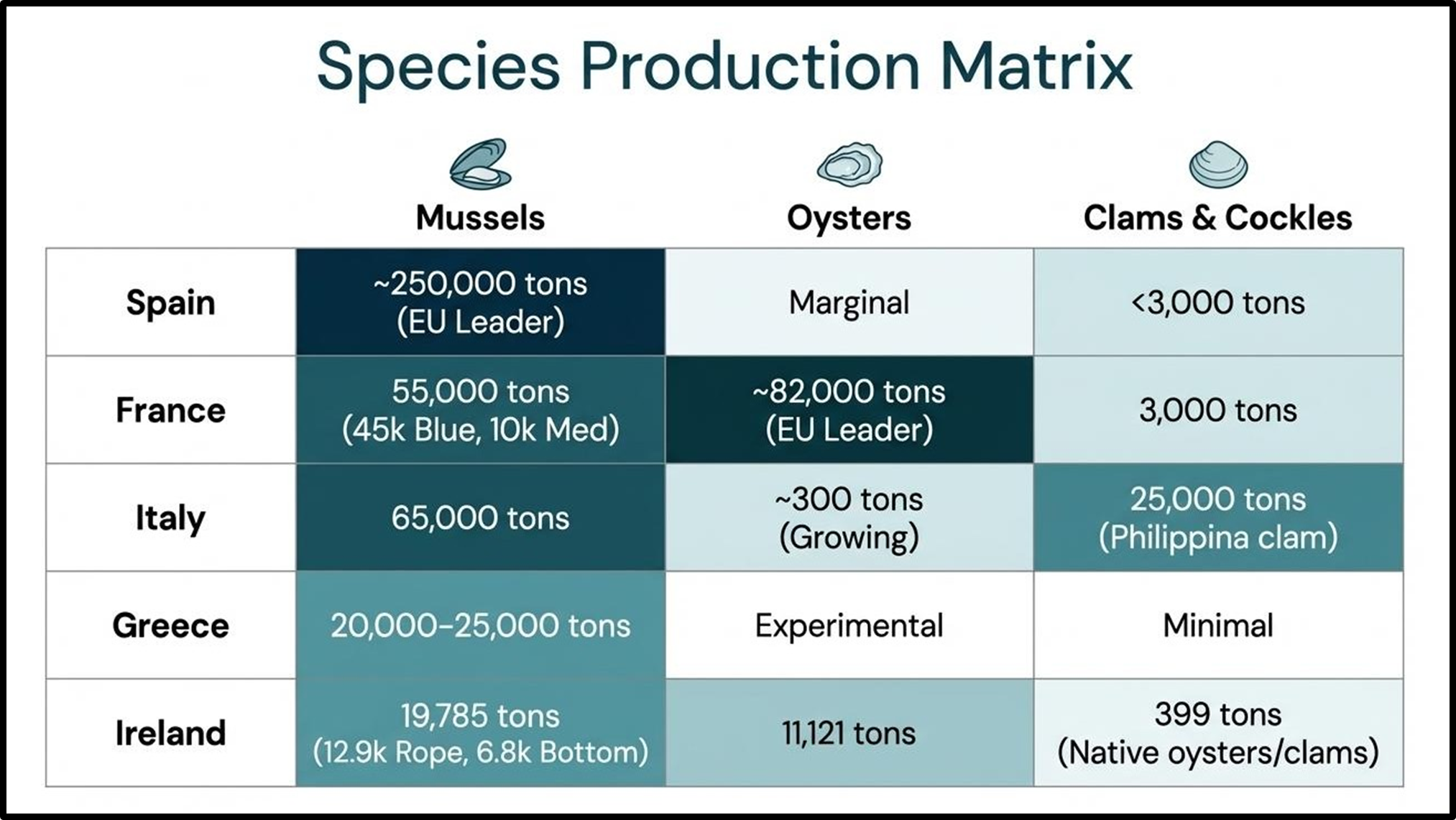
Fig. 9 - Main species farmed in the 5 countries involved in the project