Απαιτήσεις ολοκλήρωσης
2.3 Bureaucratic aspects in different countries: obtaining and renewing concessions area, quality labels or certifications
2.3.1 What types of certifications or quality labels are most common in each country? How are these certifications and labels obtained: easy or difficult process?
The modern market demands products that guarantee not only hygiene and health safety, but also a strong connection to the territory of origin, through quality brands, and proven respect for ecosystems, through sustainability certifications. In this context, bivalve aquaculture represents a particularly virtuous model from an environmental standpoint compared to other forms of farming.
These organisms grow naturally, without the use of artificial feed, drugs, or antibiotics, feeding exclusively on the phytoplankton present in the marine environment through filtration. Furthermore, bivalves play a fundamental role as "environmental engineers," providing important environmental services. Their biofiltration activity helps reduce eutrophication and decrease the organic load in coastal waters. Furthermore, their presence can promote the formation of natural habitats and reefs, especially in areas like the Adriatic, characterized by sandy bottoms and limited hard substrates.
These structures become true biodiversity hotspots, promoting the reproduction and survival of numerous marine species. Finally, the formation of calcareous shells contributes to carbon dioxide (CO2) sequestration. Although the quantification and direct monetization of these ecosystem services (for example, through carbon credits or nitrogen removal) are still in the process of regulatory development at the European level, the intrinsic sustainability of this production system is now recognized and valued through environmental certifications such as ASC (Association for the Protection of the Environment) or the organic label. However, obtaining these certifications is generally a complex, lengthy, and costly process. It requires adapting facilities, implementing complete digital traceability systems, preparing operating manuals, and undergoing inspections or audits by independent third-party bodies, with costs borne entirely by the producers.
In Spain, the main reference is the "Mejillón de Galicia" PDO, which protects the quality of mussels farmed in traditional bateas (farms). Although it is a well-established brand, the Regulatory Council's control system is extremely rigorous and requires complete traceability of juveniles (mexilla), as well as processing at authorized centers.
The Regulatory Council's goal is to maintain and promote the Protected Designation of Origin for Galician Mussels, as well as monitor and promote their quality. An organic label is also available in Spain, under the supervision of the Galician Organic Agriculture Regulatory Council (CRAEGA). The main current challenge is accessing international sustainability certifications such as MSC and ASC, which are required to officially certify the supply chain's low environmental impact. For small producers, the costs of independent audits are often prohibitive, which is why associations, consortia, and producer organizations are frequently used to share the burden of the process.
As a consumer, France is strongly tied to the concept of territory, and therefore, labels of origin are particularly important. Among the best-known are the PGI "Huîtres Marennees-Oléron" and the AOC "Moules de Bouchot de la Baie du Mont-Saint-Michel." Since May 2013, Bouchot mussels have been awarded the Traditional Speciality Guaranteed Certification. In addition to their prestige, the Label Rouge, which certifies superior organoleptic quality, and the organic certification (AB-Agricolture Biologique), which recognizes the absence of chemical inputs and a natural farming cycle, are also widely available.
The main challenge in France is the extremely strict adherence to specifications. In the case of organic certification, for example, the challenge lies in demonstrating compliance throughout the entire production cycle, including natural juveniles, as well as the constant maintenance of waters classified as excellent (Class A).
In Italy, the promotion of territorial brands prevails, as demonstrated by the Cozza di Scardovari, the first to obtain the PDO, and other emerging products such as the Cozza Tarantina. On the sustainability front, several cooperatives, especially in the Northern Adriatic, are gradually obtaining ASC and organic certifications. According to SINAB data, the organic aquaculture sector has approximately 70 operators, largely concentrated in shellfish farming. The main production areas are Veneto (approximately 28 operators) and Emilia-Romagna (approximately 20 operators). However, the diffusion of certifications in the sector remains limited. Specifically, organic certification, while representing an opportunity to enhance product value, still accounts for a marginal share of total production due to high compliance costs and the complexity of the regulatory framework. Furthermore, the Italian mussel farming sector is characterized by growing pressure towards sustainable practices, primarily related to environmental impact management and the adoption of circular economy models. Despite this, the sector's development is hampered by supply chain fragmentation and bureaucratic complexity. Organic and ASC certifications require in-depth environmental analyses, such as benthic impact assessments, as well as compliance with stringent social and environmental standards. Furthermore, advanced water quality and microbiological risk monitoring systems are required, which are essential for ensuring food safety and compliance with international standards. This creates an administrative and financial burden that is difficult for individual cooperatives to sustain without adequate specialized support. There are also additional barriers to certification adoption, including operator perceptions and limited access to financial and innovative tools, despite growing market interest in certified and sustainable products.
Ireland has a sector highly oriented towards the export of premium products and innovation in production processes. The aim is to increase resource efficiency, strengthen the "social license to operate," improve food quality and safety, and enhance sustainability credentials. In this context, the Irish aquaculture sector relies on two important benchmarks: the national Origin Green program, promoted by Bord Bia, and the Certified Quality Aquaculture (CQA) standard developed by BIM (Bord Lascaigh Mhara). Origin Green is the only state-run food sustainability program in the world, perfectly aligned with the narrative of the ecosystem services provided by oysters and mussels. Launched in 2012 and extended to primary aquaculture producers since 2015, the program stands out because it requires member companies to define measurable objectives across the various sustainability pillars, which must be met to maintain certification. Additionally, certification by the Marine Stewardship Council (MSC), one of the most globally recognized labels for sustainable fishing and seafood, has certified Irish mussel farming as sustainable since 2019. This allows producers to access the MSC label, with benefits in terms of reputation, product visibility, and access to new markets to attract new consumers. Irish mussels certified under the Quality Seafood Scheme must meet specifications relating to meat content, shell appearance, flavor, and texture. The Irish Quality Mussel Scheme is the first fully integrated shellfish certification system in the world to be accredited according to EN45011, the international standard for product quality certification. Thus, a growing share of companies in the sector have adopted these practices, allowing us to monitor the diffusion of production innovation as a percentage of all active companies. However, the main challenge lies in maintaining standards: since quality depends directly on the natural conditions of the water, even temporary pollution episodes, such as those caused by heavy rainfall and agricultural or sewage runoff, can lead to the immediate suspension of certification, resulting in significant economic losses.
In Greece, the mussel farming sector is lagging behind in the development of European-recognized certifications of origin. In the absence of established PDO or PGI, international market pressure is pushing the adoption of food safety standards (ISO 22000, IFS, and BRC) and environmental certifications such as ASC. The main challenge in Greece is the limited cooperation among producers. Many farmers operate independently and perceive certifications as a bureaucratic and costly burden, rather than a tool for valorization.
This limits the sector's ability to organize into consortia capable of sustaining costs and effectively promoting the product's environmental benefits on international markets. Furthermore, unlike the rather flexible policy framework in Europe, mussel farming is heavily influenced by the state concession system, which limits farm size to less than three hectares, a condition that negatively impacts economic sustainability. This institutional rigidity, combined with high financial risk and limited access to credit, hinders the sector's growth and industrialization. Consequently, the adoption of certification systems and quality labels is also limited, as it requires investment and more advanced organizational structures.
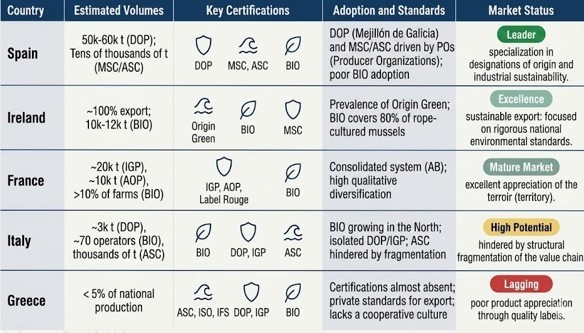
Fig. 18 - Comparison between the main European countries by type of certification and state of market development.